Naan Binary
Multitask seq2seq model for recipe generation and nutritional regression.
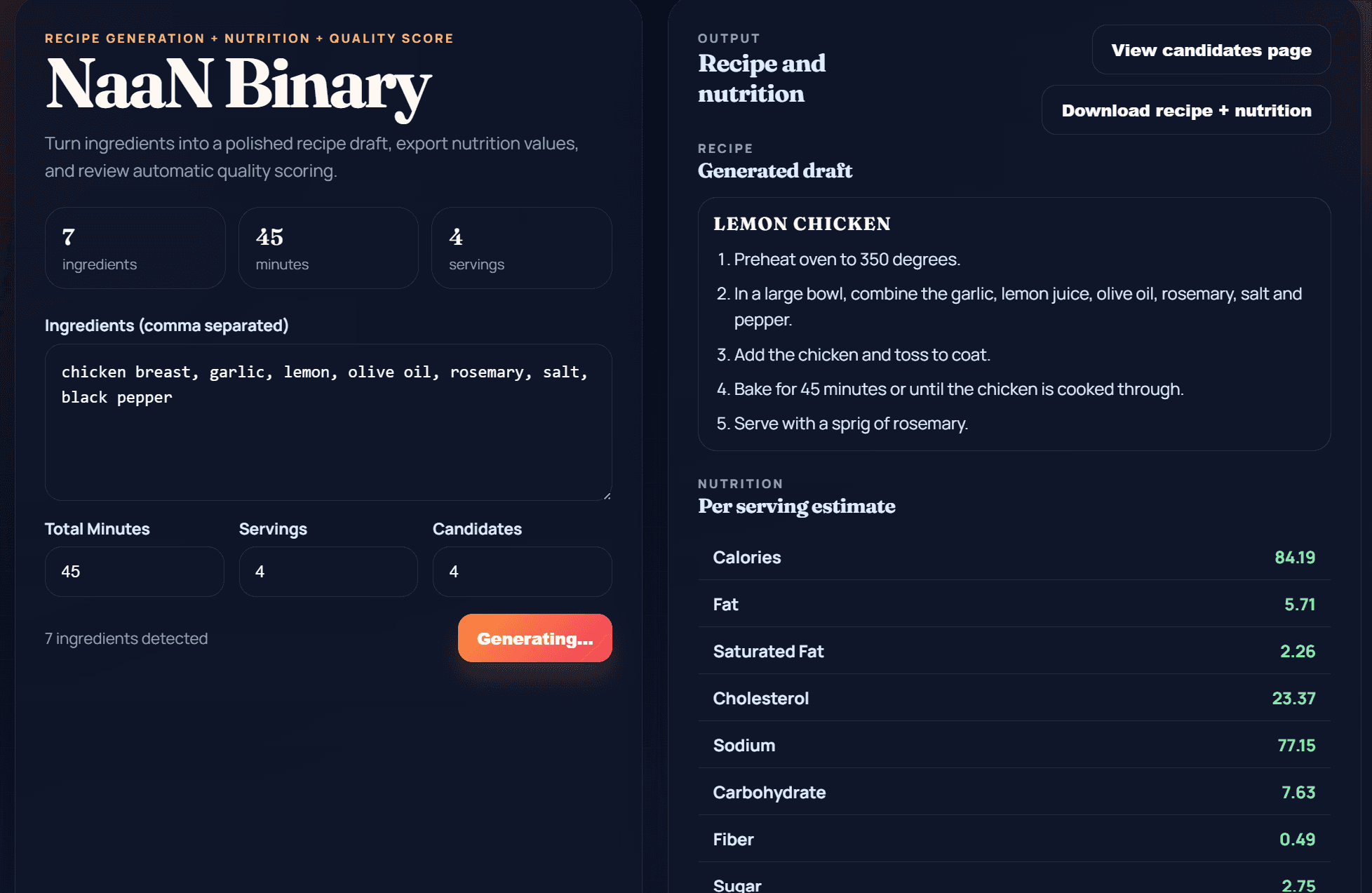
Overview
Naan Binary is a multitask deep learning system that takes a list of ingredients as input and generates a full recipe while predicting its nutritional profile.
It extends FLAN-T5 with a custom regression head trained jointly on generation and nutrition targets from the Food.com dataset.
Problem
Recipe generation models typically treat the task as pure text generation, ignoring structured nutritional output that users actually care about.
Training a capable seq2seq model under hardware constraints required careful decisions around batch size, precision, and dataset sampling.
- —Single-task models can't jointly optimize for fluent text and accurate numeric regression.
- —Food.com dataset is large and noisy, requiring cleaning and sampling strategies.
- —Training on a T4 GPU (Google Colab) limits batch size and sequence length.
Constraints
Hardware limits
Training was constrained to a T4 GPU on Google Colab, requiring mixed precision, gradient checkpointing, and careful sequence length tuning.
Multitask balancing
The generation loss and regression loss needed careful weighting to prevent one task from dominating training.
Data quality
Food.com recipes had inconsistent formatting, missing nutrition fields, and extreme outliers requiring targeted preprocessing.
Key Decisions
FLAN-T5 as backbone
Chose FLAN-T5 for its strong instruction-following pretraining, which transfers well to structured generation tasks like recipes.
Shared encoder, split heads
The encoder is shared between the generation decoder and the regression head, allowing both tasks to benefit from the same ingredient representations.
Colab T4 migration
Migrated from a local RTX 4060 to Google Colab T4 to enable longer training runs, adapting the pipeline for cloud-based checkpointing.
Results
- —Produced a working multitask model capable of generating structured recipes from raw ingredient lists.
- —Nutrition regression head converged alongside the generation objective with balanced loss weighting.
- —Framed hardware-constrained results appropriately in the project report for academic evaluation.
Takeaways
- —Multitask learning requires deliberate loss balancing — naive summation rarely works out of the box.
- —Pretrained seq2seq models carry strong priors that make structured generation tasks more tractable.
- —Training infrastructure decisions (precision, checkpointing, batch size) matter as much as architecture choices under hardware constraints.